 RAV4 Transmission Fluid Guide
Drain-and-fill vs flush vs pan drop: which service does a 2012 RAV4 actually need?
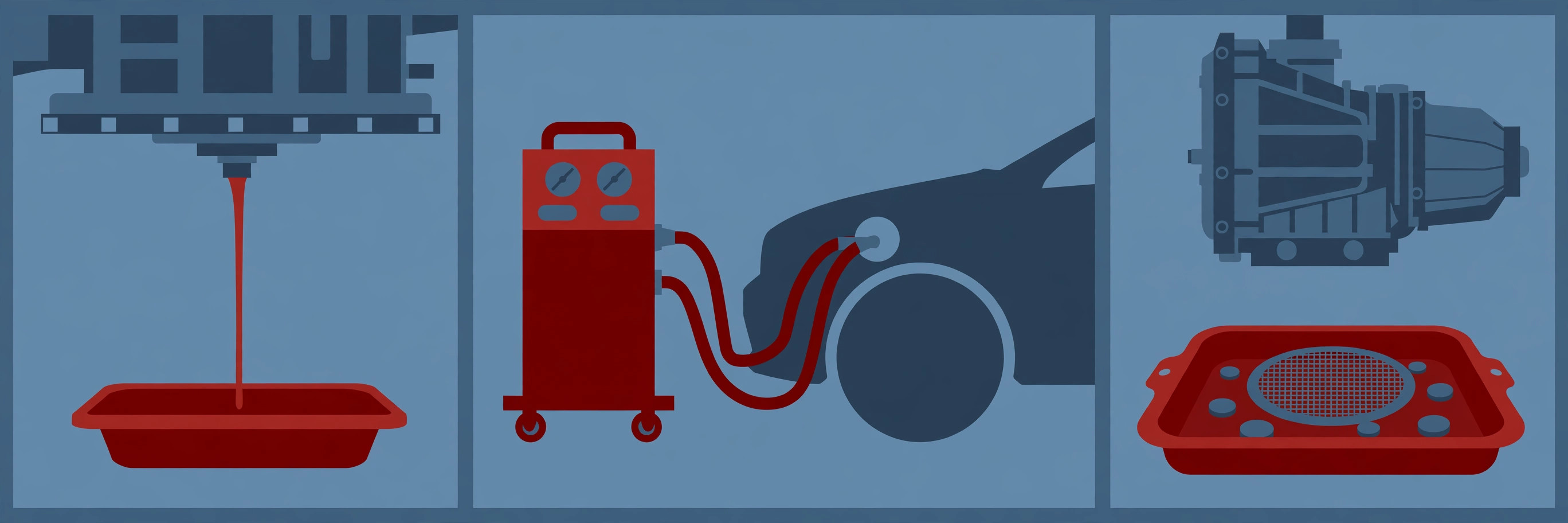
Three different services hide behind the phrase "transmission fluid change," and shops don't always mean the same thing by it. A drain-and-fill swaps the fluid in the pan. A flush (more accurately, a fluid exchange) pushes old fluid out and new fluid in until nearly all of it is fresh. A pan drop is a drain-and-fill plus opening the transmission up — cleaning the pan, reading the magnets, and replacing the internal strainer. For a 2012 RAV4 — a vehicle now well into its second decade, often with an incomplete service history — the right choice depends less on which service is "best" in the abstract and more on what you know, and don't know, about your transmission. Here is each method honestly, including the controversy.
⚠ Safety applies to all three: hot fluid burns; the vehicle belongs on jack stands or a lift, never on a jack alone; used fluid goes to a recycling depot, sealed and labelled.
Option 1: The drain-and-fill
What it is. Open the pan's drain plug, let gravity empty the pan (roughly 3.5 quarts on the four-cylinder; about 3.5 to 4 on the V6), refit the plug with a new gasket torqued to 47 N·m (35 ft·lbf), and refill the measured amount of Toyota ATF WS through the dipstick tube. The step-by-step guide covers it in full.
How much fluid it changes. About 40 percent of the total. The manual's total capacities — 8.6 quarts (four-speed) and 9.3 quarts (five-speed) — include the torque converter, valve body, and cooler circuit, which do not drain through the pan. This is the method's real limitation, and the honest fix is repetition: a second drain-and-fill after some driving brings the fresh share to roughly two-thirds.
Strengths. Gentle, cheap, entirely DIY-able on this vehicle thanks to the dipstick, and self-limiting in risk: you change a modest fraction of the fluid, with the exact fluid Toyota specifies, and nothing is pressurised or disconnected. It is also diagnostic — you see, smell, and measure the old fluid.
Weaknesses. Partial by design. The strainer and magnets stay untouched, so if the pan holds a heavy load of debris, a drain-and-fill leaves it there (the strainer keeps screening, but you learn nothing about what's accumulating).
Option 2: The flush (fluid exchange)
What it is. A machine connects into the transmission's cooler lines. As the transmission pumps old fluid out toward the cooler, the machine feeds fresh fluid in, until the outflow runs clean — typically using more fluid than the total capacity, to purge thoroughly. Done well with the correct fluid, it is the only method that approaches a complete fluid change in one visit.
Toyota's position — worth knowing before you book one. Toyota's service bulletin on ATF WS states the fluid is on a 100,000-mile inspection interval and "does NOT require any flushing or changing during the life of the vehicle" under normal conditions, and warns against substitute fluids and additives. That doesn't make every exchange harmful, but it does mean a flush is never something Toyota asks for on this vehicle — it is a choice, not a requirement, and anyone selling it as factory-scheduled maintenance for a normally-driven RAV4 is overselling.
The risks, stated fairly. On a healthy, regularly maintained transmission, an exchange with genuine ATF WS is generally uneventful. The trouble cases cluster around neglected, high-mileage units with symptoms already present: debris stirred from the pan and cooler can lodge in the valve body; some machines introduce the shop's universal fluid rather than WS (a genuine problem on this vehicle — see the do's and don'ts); and a complete, sudden change from very old fluid to fully detergent-fresh fluid is the scenario behind the long-running "the flush killed my transmission" stories — usually, in truth, a transmission that was already failing and got its post-mortem scheduled at the flush. The prudent reading: an exchange is a reasonable service on a known, healthy transmission; it is a gamble as a first intervention on an unknown one.
Cost shape. The most expensive of the three, because it consumes the most fluid and shop equipment time. (We don't quote prices here — they vary too much by region and shop to state honestly.)
Option 3: The pan drop (drain, pan service, strainer replacement)
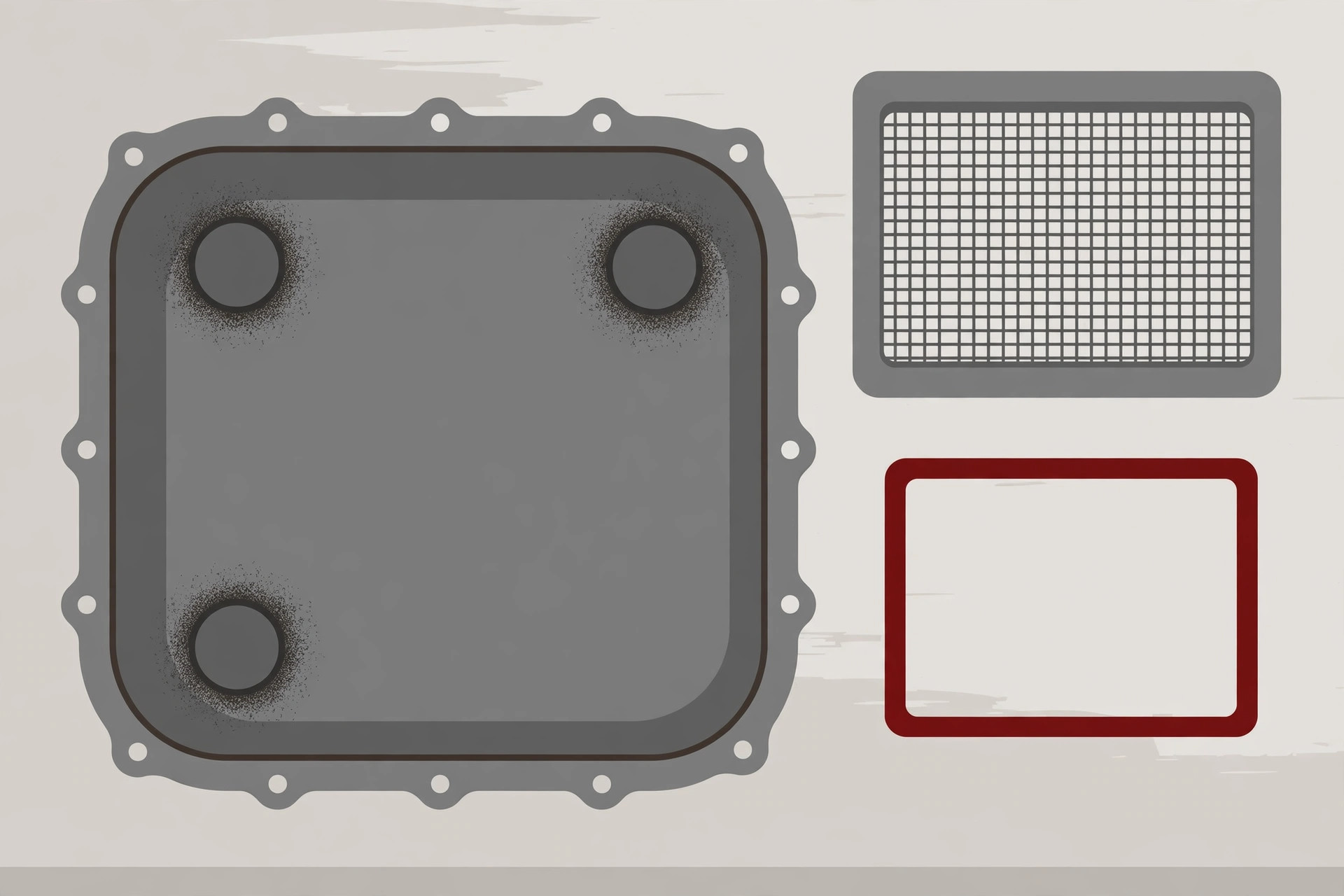
What it is. Everything in a drain-and-fill, then more: with the fluid drained, unbolt the pan (18 bolts on this transmission family), lower it carefully — some fluid always remains in it — and you gain access to the inside of the transmission's sump. Clean the pan, clean and examine the three magnets, replace the pan gasket, and unbolt the oil strainer (3 bolts, torqued to 11 N·m / 8 ft·lbf on refitting) to fit a new one with a fresh O-ring. Refit the pan with bolts torqued evenly to 7.6 N·m (67 in·lbf) — a gentle, even squeeze in a criss-cross pattern, not a strong-arm contest, because the gasket seals by uniformity, not force.
What the magnets tell you. The factory manual instructs technicians to collect particles with the removed magnets and interpret them: steel (magnetic) particles point to bearing, gear, and plate wear; brass (non-magnetic) points to bushing wear. A thin coat of fine grey fuzz on a high-mileage unit is normal life. Coarse flakes, slivers, or chunks are the transmission asking for a specialist. No other service gives you this information.
How much fluid it changes. Slightly more than a drain-and-fill — the pan and strainer hold a little extra — but still a partial change. Its value is inspection and renewal of the strainer, not fluid volume.
Strengths. The most informative service; the only one that renews the strainer; still fully DIY-able; pairs naturally with a drain-and-fill (it is one, plus the pan work).
Weaknesses. The messiest and slowest of the three; a gasket refitted carelessly can leak where the old one didn't; and on a vehicle whose pan has never been off, expect some bolts to argue. It also demands the same new drain-plug gasket and torque discipline as the basic job.
Side by side
| Drain-and-fill | Flush / exchange | Pan drop | |
|---|---|---|---|
| Fluid replaced | ~40% per cycle | Nearly all | ~40–45% |
| Strainer renewed | No | No | Yes |
| Magnets/pan inspected | No | No | Yes |
| DIY-friendly (2012 RAV4) | Yes | No — shop machine | Yes, slower |
| Risk on a neglected unit | Low | Highest of the three | Low |
| Toyota's stance | Consistent with inspection-based service | Not required by Toyota | Standard factory service work |
So which does your RAV4 need? A decision path
- Known history, fluid serviced before, no symptoms: a drain-and-fill is the proportionate service. Repeat it on the severe-service rhythm if the vehicle tows or works hard (see when to change).
- Unknown history — you bought it used and the fluid's age is a mystery: start with a drain-and-fill and read what comes out. Clean-ish dark red? Proceed, and consider a second cycle. Very dark, burnt-smelling, or glittery? Make the next step a pan drop, not a flush, and read the magnets before deciding anything else.
- High mileage with shift symptoms already present: diagnosis before fluid heroics. Fresh fluid is a legitimate early step (it is cheap and sometimes genuinely curative when the level was low or the fluid exhausted), but a flush is the last thing a symptomatic, neglected transmission needs. The symptoms guide sorts the cases.
- You simply want the most complete renewal on a healthy transmission: either a series of two or three drain-and-fills spaced by real driving, or a shop exchange — with the fluid question settled in advance, in writing if necessary: genuine Toyota ATF WS, no additives. If a shop won't agree to that, the drain-and-fill series is your answer.
The through-line: on this vehicle, patience beats pressure. The dipstick-equipped third-generation RAV4 rewards the measured approach — change some fluid, learn from it, and escalate only when the evidence says to.