 RAV4 Transmission Fluid Guide
Transmission fluid change do's and don'ts
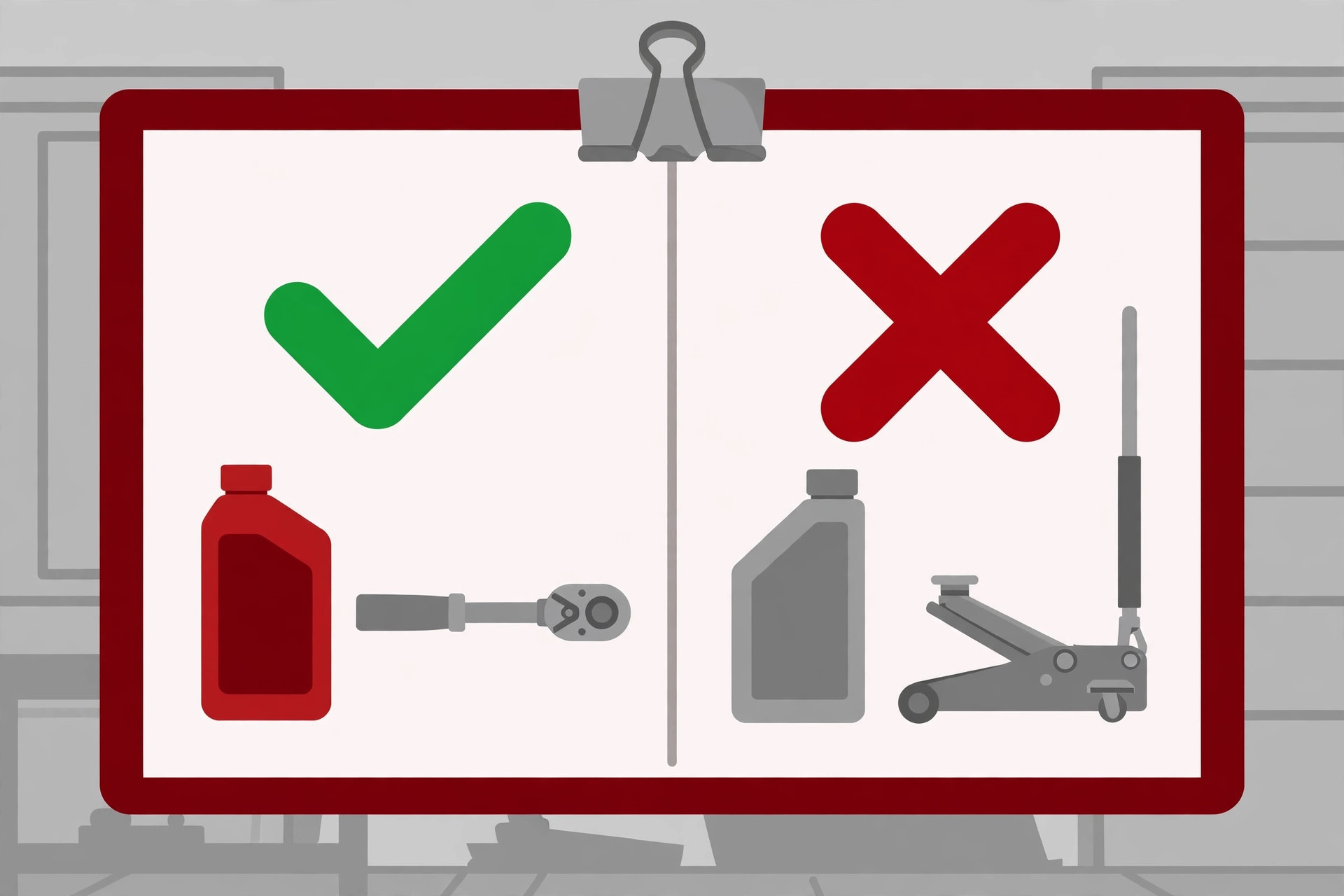
Most transmission fluid jobs don't go wrong in complicated ways. They go wrong on a short list of simple things: the wrong fluid, a guessed quantity, a reused gasket, a level checked at the wrong temperature, a vehicle held up by the wrong equipment. This is that list for the 2012 RAV4, with the reason behind each item — because a rule you understand is a rule you actually follow. Read it once before your first drain-and-fill (the step-by-step guide puts it all in order), and keep it open while you work.
⚠ The three that protect you, not the car: work on level ground with the vehicle on jack stands — never a jack alone; treat the fluid as a burn hazard, because at operating temperature it is one; and seal used fluid in a jug for a recycling depot, never a drain. Everything below assumes those three.
The do's
Do use Toyota Genuine ATF WS — and only ATF WS
This is the rule with no exceptions on this vehicle. The 2012 owner's manual specifies Toyota Genuine ATF WS and prints a notice worth quoting in spirit: using a fluid other than ATF WS can degrade shift quality, cause the transmission to lock up with vibration, and ultimately damage it. Toyota's service bulletin on WS fluid adds that WS is not compatible with the older Type T-IV or Dexron fluids. ATF WS is a specific, relatively low-viscosity fluid whose friction characteristics are matched to the clutches and the torque-converter lock-up strategy in these Aisin-built transmissions. "Meets many specs" on a bottle is not the same as being this spec.
Do measure exactly what drains out
Your graduated jug is the most important tool in the job. A pan drain releases roughly 3.5 quarts on the four-cylinder and 3.5 to 4 quarts on the V6, but your vehicle is the authority, not a chart: pour the same measured amount of fresh fluid back in, and the level starts where it was. Measuring also turns the drain into a diagnostic — if a litre less than expected comes out, the transmission was running low, and you now get to find out why (a seeping pan gasket, a wet axle seal, a cooler line) instead of discovering it later through shift complaints.
Do replace the drain-plug gasket every time
The factory procedure calls for a new gasket whenever the plug comes out, because the washer seals by crushing. A once-crushed washer asked to seal again is the single most common cause of the slow drip that appears a week after an otherwise perfect job. The gasket costs very little; the second time under the car costs an afternoon. Torque the plug to spec while you're at it — 47 N·m (35 ft·lbf) on this transmission — rather than by feel.
Do work on level ground, and confirm the vehicle is level again for the level check
Two different parts of the job depend on it. A tilted vehicle leaves old fluid pooled in the pan away from the drain, and — more importantly — a dipstick reading taken on a slope is simply wrong, by an amount that grows with the slope. The factory level-check procedure begins with "park the vehicle on a level surface" for exactly this reason. If your driveway slopes, do the drain wherever is safe, but do the final level check somewhere flat.
Do check the level at full operating temperature, engine idling
ATF expands as it heats, and the dipstick's HOT range is calibrated for fluid at 70 to 80 °C (158 to 176 °F). The factory sequence: warm the vehicle fully, idle the engine, work the lever through the gears and back to Park, then pull, wipe, reinsert, and read the dipstick. Anything else — a cold engine, a shut-off engine, a quick idle in a cold driveway — produces a number that looks precise and isn't. See the don'ts below for what a cold check leads to.
Do cycle the shifter through every gear before checking
After a refill, parts of the hydraulic circuit are partially empty. Idling and moving the lever slowly from Park through each position (foot firmly on the brake) and back fills the valve body and converter circuits so the dipstick is measuring a settled, complete system. Skipping this step is how a transmission ends up a pint low with a "correct" reading.
Do keep everything clean — funnel, dipstick, bottles
An automatic transmission is a hydraulic computer that runs on fluid cleanliness; the strainer inside is a coarse mesh, not a fine filter, and grit that enters through the dipstick tube stays in circulation. Wipe the dipstick with lint-free material only, rinse and dry the funnel before use, keep bottle caps on until the moment of pouring, and don't set the dipstick down on a dirty bench. Toyota adds a storage rule for the fluid itself: ATF WS absorbs moisture from the air, so keep containers sealed — an opened bottle that's been sitting for a year belongs at the recycling depot, not in your transmission.
Do read the old fluid before you throw it away
The drained fluid and the drain plug are a free health report. Dark red and translucent: normal ageing. Brown: tired, overdue, but not alarming on its own. Near-black with a burnt smell: the fluid has been overheated or worked far past its best, and the transmission deserves a closer look. Fine grey fuzz on a pan-drop's magnets: ordinary wear. Visible flakes, chunks, or brass-coloured particles: wear metals from bearings, gears, plates, or bushings — a diagnosis conversation, not a fluid conversation. Five seconds of looking now sets realistic expectations for what fresh fluid should accomplish.
Do repeat the drain-and-fill if you want more fresh fluid
One drain-and-fill replaces roughly 40 percent of the total fluid (the manual lists total capacity at 8.6 quarts for the four-speed, 9.3 for the five-speed; a pan drain yields roughly 3.5 to 4). A second drain-and-fill after some normal driving raises the fresh share to about two-thirds, a third higher still — each time gently, at pan-drain cost, with no machine. This "serial dilution" is the patient owner's flush, and it suits an older transmission far better than pressure.
Do dispose of the old ATF properly
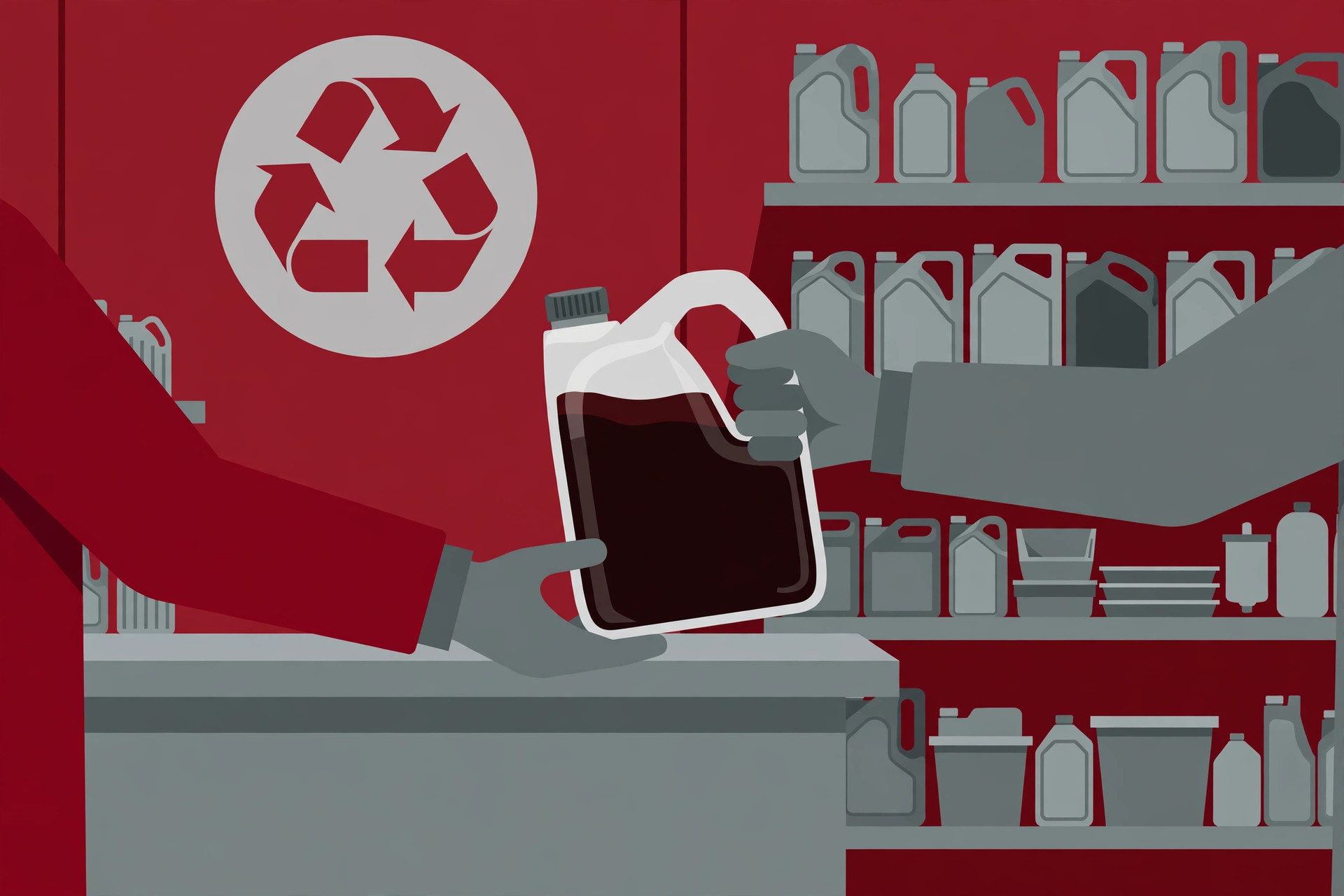
Used transmission fluid is hazardous waste. Cool it, seal it in a labelled jug (the empty new-fluid bottles are ideal), and take it to an automotive recycling depot or a retailer that accepts used oil. Keep it unmixed with coolant, brake cleaner, or gasoline — contaminated loads are the ones depots refuse. This is not a formality: a single careless pour reaches groundwater, and shops have been fined for less.
Do write it down
Date, odometer, how much came out, how much went in, and what the old fluid looked like. A 2012 RAV4 with a legible fluid-service history is worth more, maintained better, and diagnosed faster than one running on folklore — and the second drain-and-fill's timing depends on remembering the first.
The don'ts
Don't use universal or multi-vehicle fluid
The mirror image of the first do, and worth its own entry because the marketing is persuasive. A fluid claiming to cover dozens of specifications is, by construction, exactly right for none of them — its viscosity and friction profile are a compromise. In a transmission whose lock-up clutch and shift timing are calibrated around WS's specific behaviour, the compromise shows up as shudder, flare, or harsh shifts — the very symptoms owners then blame on the fluid change itself. Toyota's bulletin is blunt: substitutes and additives "may result in shift concerns and damage to the internal transmission components." Use WS.
Don't mix fluids
Partial bottles of different fluids don't average out to a correct fluid; they average out to an unknown one. This includes topping up WS with Type T-IV "because it's also Toyota fluid" — Toyota states the two are not compatible. If you can't get WS, the correct move is to wait until you can. The one mixing that is fine — unavoidable, in fact — is fresh WS meeting the WS already in the converter during a drain-and-fill: same fluid, different age.
Don't overfill
An overfilled automatic transmission churns its fluid into foam. Foam compresses, so hydraulic pressure fluctuates; shifts go soft or erratic; fluid expands and finds its way out of the vent and seals, painting the underside and imitating a leak. Owners overfill mainly by checking the level cold (below) or by pouring in a chart quantity instead of a measured one. If you do overshoot, draw the excess out through the dipstick tube with a clean suction pump — don't "drive it off."
Don't check the level cold
Cold ATF sits lower on the dipstick than hot ATF in the same transmission. "Topping up" a cold reading to the HOT mark therefore guarantees an overfill at operating temperature, with the foaming and venting described above. The factory check is explicit — fluid at 70 to 80 °C, engine idling, after a full warm-up and a trip through the gears. There is no accurate shortcut version of this check.
Don't rely on a jack alone — ever
The heaviest rule on this page. A hydraulic jack is a lifting device, not a supporting device; seals weep, valves get bumped, and vehicles roll. Jack stands on solid, level ground, the parking brake set, wheels chocked — or proper drive-on ramps. If the setup feels improvised, it is: stop and fix the setup, not the fluid.
Don't flush a high-mileage, neglected transmission without inspecting it first
The caution is about sequence, not superstition. A pressure flush on a transmission with unknown history, very dark or burnt fluid, or existing shift symptoms can stir debris into the valve body and cooler, and it replaces all the fluid at once — removing, in one step, fluid whose high detergent load of suspended clutch material may have been masking worn components. Toyota's own position is that ATF WS does not require flushing at all. The inspection-first path: drain-and-fill, read the fluid and (better) drop the pan and read the magnets and strainer, then decide. Drain-and-fill vs flush vs pan drop works through the choice in full.
Don't reuse the old gasket, and don't guess the torque
Covered above as a do; repeated here because it fails as a don't so often. Old washer plus "feels tight" equals the classic comeback drip. New washer, torque wrench, 47 N·m (35 ft·lbf). Ten extra minutes, zero drips.
Don't add sealers, conditioners, or "shift fix" additives
Toyota's WS bulletin warns against aftermarket additives in these transmissions. Beyond that, additives treat a symptom by changing the fluid's behaviour globally — swelling seals or altering friction everywhere — which is a poor trade in a transmission whose problem you haven't diagnosed yet. If a transmission has a mechanical fault, no bottle fixes it; if it doesn't, no bottle is needed.
Don't mistake the engine oil drain plug for the transmission's
Two similar pans live under the front of this vehicle, close together. Draining engine oil and refilling the transmission is a documented, expensive beginner error — and so is the reverse. Before the ratchet turns, identify the pan by the unit it bolts to, and cross-check from above: the transmission dipstick tube leads to the transaxle. If you are not certain, you are not ready to drain.
Don't expect fresh fluid to repair worn hardware
Fresh fluid and a correct level can cure a surprising list of complaints — lazy shifts from tired fluid, shudder from depleted friction modifiers, flare from a low level. They cannot regrow a worn clutch pack, unstick a failed solenoid, or repair a bearing. The symptoms guide sorts which is which; keep expectations honest and you'll judge the job by the right standard.