 RAV4 Transmission Fluid Guide
Fluid, filter & parts for the 2012 RAV4: ATF WS, capacities, gaskets and the strainer
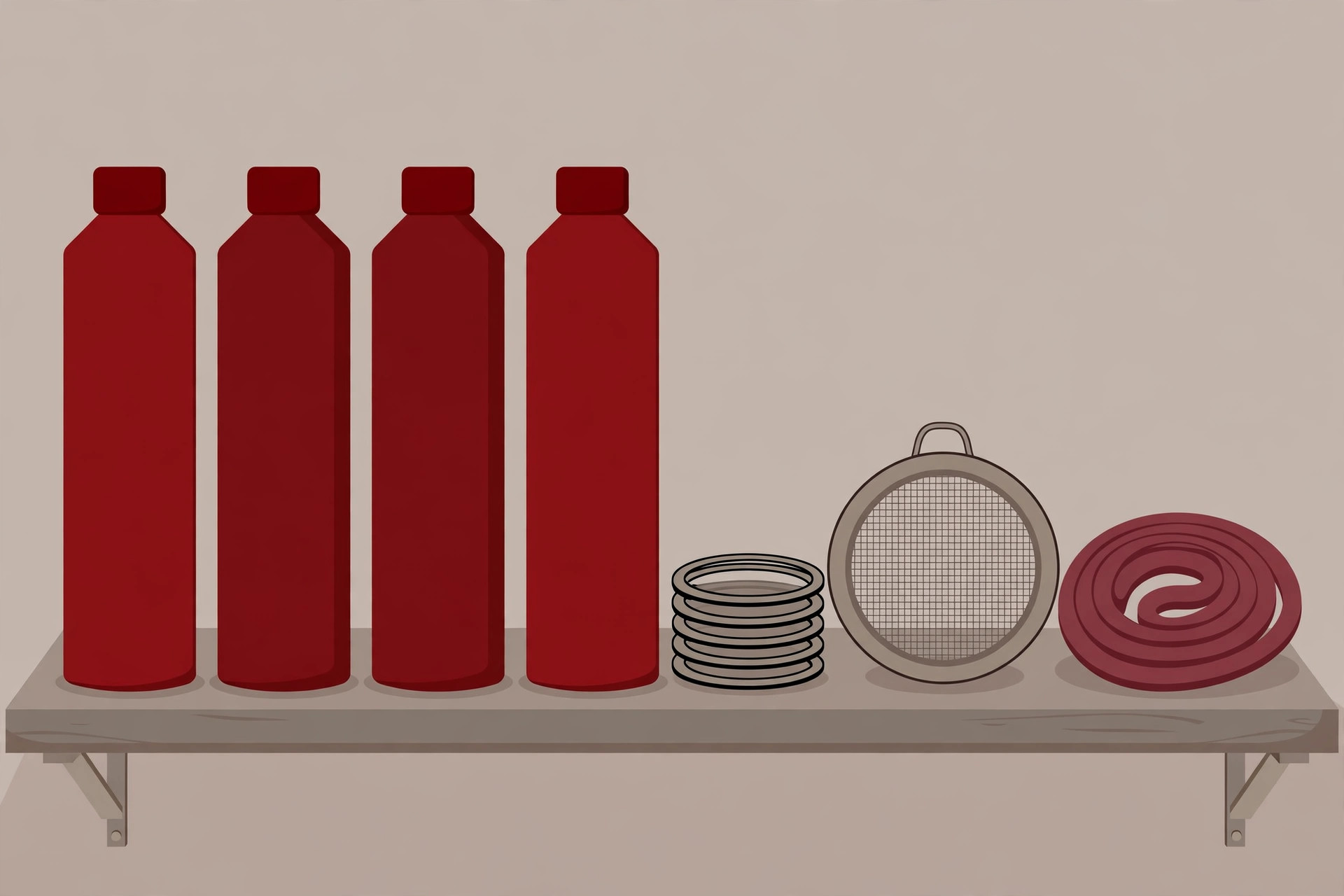
A transmission service is only as good as the parts and fluid that go into it, and on the 2012 RAV4 the shopping list is short but unforgiving: one specific fluid, two gaskets most people forget, and a "filter" that isn't quite what the word suggests. This page collects the verified factory numbers in one place — the capacities from the owner's manual, the torques from the factory repair manual for this transmission family — and explains the reasoning so the numbers mean something. Where a figure is an expectation rather than a specification (like how much fluid a drain actually yields), it is labelled as one.
⚠ Safety: parts and fluid are handled under and around a raised vehicle and hot fluid. Jack stands on level ground, never a jack alone; gloves and eye protection; used fluid sealed and taken to a recycling depot.
The fluid: Toyota Genuine ATF WS, full stop
The 2012 RAV4 owner's manual specifies Toyota Genuine ATF WS and prints a formal notice: using a fluid other than ATF WS "may cause deterioration in shift quality, locking up of your transmission accompanied by vibration, and ultimately damage the automatic transmission of your vehicle." Toyota's dedicated service bulletin on WS (World Standard) fluid reinforces the point from several directions:
- ATF WS is not compatible with Type T-IV or Dexron fluids — the older Toyota fluids are not fallbacks.
- Aftermarket fluids marketed as compatible substitutes, and fluid additives, "may result in shift concerns and damage to the internal transmission components."
- WS is one-time use: fluid drained from the transmission is never reused.
- WS absorbs moisture from the air, so containers must stay sealed until use — a half-bottle stored open is not a top-up reserve.
Why so strict? WS is engineered as a system component, not a commodity. It is a comparatively low-viscosity fluid whose friction modifiers are tuned for the clutch materials and the torque-converter lock-up clutch behaviour these transmissions are calibrated around. A "multi-vehicle" fluid splits the difference across dozens of specifications; in a WS transmission, that difference is exactly where shudder and shift flare live. Buy the genuine fluid — it is the cheapest insurance in the entire job — and buy it in sealed quart bottles so you can measure your refill precisely.
Capacities: the factory numbers
| Figure | 2.5L four-cylinder (4-speed automatic) | 3.5L V6 (5-speed automatic) |
|---|---|---|
| Total fluid capacity (owner's manual) | 8.6 US qt (8.1 L) | 9.3 US qt (8.8 L) |
| Typical drain-and-fill yield (expectation, not a spec) | ≈ 3.5 US qt | ≈ 3.5–4.0 US qt |
| Fluid type | Toyota Genuine ATF WS | |
The gap between the two rows confuses people the first time, so it deserves a plain explanation. The total capacity is everything the transmission holds: pan, torque converter, valve body, cooler, and lines. A pan drain only empties the pan — the converter and circuits keep their fluid, by design. That's why the working rule of the drain-and-fill is measure what came out and put that amount back, and why nobody should ever pour in 8.6 quarts after a pan drain. It is also why a single drain-and-fill is honestly described as a partial service, and why repeated cycles are the standard way to raise the fresh-fluid share (see the methods comparison).
How much to buy: 4 quarts covers one drain-and-fill on either engine with a small margin for level adjustment. If you plan the popular second cycle, buy for both at once and keep the extras sealed.
The "filter" is a strainer — and that changes how you treat it
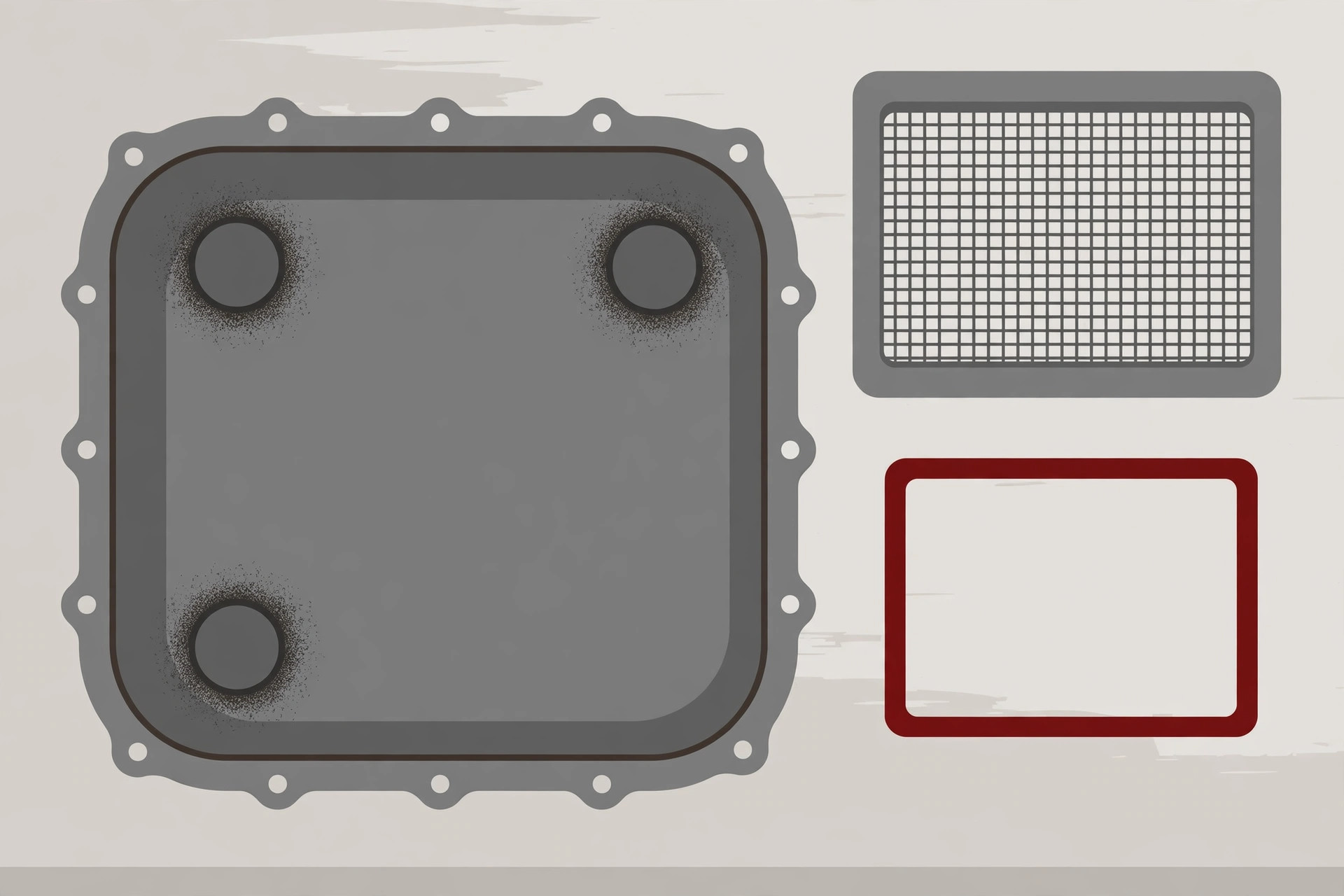
Parts catalogues will sell you a "transmission filter kit" for this vehicle, but inside the pan there is no pleated paper filter like an engine oil filter. There is an oil strainer: a mesh-screen assembly that keeps large debris out of the pump intake. The distinction matters for two reasons. First, a strainer doesn't gradually clog the way a paper element does, which is one reason Toyota's service model for these transmissions is inspection-led rather than filter-swap-led. Second, when you do open the pan, the strainer's condition is diagnostic: a strainer loaded with material means a lot of material was circulating.
Factory details for a pan-drop service on this transmission family: the strainer is retained by 3 bolts, torqued to 11 N·m (8 ft·lbf), and seals with an O-ring that should be renewed (coat the new O-ring with ATF before fitting). The pan itself carries three magnets, which you remove, clean, and read — steel particles indicate bearing, gear, and plate wear; brass-coloured particles indicate bushing wear, per the factory manual — before refitting them in their original spots. The pan is held by 18 bolts, torqued evenly to 7.6 N·m (67 in·lbf) against a new pan gasket: a light, uniform clamp in a criss-cross pattern. Over-torquing pan bolts distorts the flange and causes the leak people then blame on the gasket.
The small parts list
- Drain-plug gasket (crush washer) — one per drain, non-negotiable. The factory procedure fits a new gasket and torques the plug to 47 N·m (479 kgf·cm, 35 ft·lbf).
- Pan gasket — only if you're dropping the pan; always new, never reuse the old one, and no sealant smeared on "for insurance" unless a kit specifically instructs it.
- Oil strainer + O-ring — for a pan drop; sold as a kit with the pan gasket by many suppliers. Match it to your transmission (four-speed vs five-speed) when ordering.
- ATF WS — 4 quarts per drain-and-fill, sealed bottles.
A note on buying: we deliberately don't list part numbers here. Toyota revises and supersedes numbers over time, kits vary by supplier, and a wrong-but-confident number is worse than none. Order by VIN at a dealer parts counter or a reputable catalogue, and confirm "four-speed or five-speed" matches your engine — 2.5L means the four-speed, 3.5L V6 means the five-speed.
Torque summary (factory repair manual, this transmission family)
| Fastener | Torque |
|---|---|
| Drain plug (with new gasket) | 47 N·m (35 ft·lbf) |
| Oil strainer bolts (×3) | 11 N·m (8 ft·lbf) |
| Pan bolts (×18, even criss-cross pattern) | 7.6 N·m (67 in·lbf) |
Two of these numbers deserve respect for opposite reasons. The drain plug's 47 N·m is higher than many expect — guess low and it seeps. The pan bolts' 7.6 N·m is lower than most hands guess — it's inch-pounds territory, and a standard ratchet "snug" can exceed it several times over. Use a torque wrench on both, and for the pan, one that reads accurately at the bottom of its range.
Level-check reference
Because the parts table above tends to get bookmarked, here is the companion procedure in one paragraph: fluid at 70 to 80 °C (158 to 176 °F), vehicle level, engine idling, lever moved slowly through all positions and back to Park; pull the dipstick, wipe with a lint-free cloth, reinsert fully, withdraw, and read — the correct level is within the HOT range. The 2012 is among the last RAV4s with a dipstick at all (the following generation moved to a sealed overflow procedure), which is precisely what makes this service so manageable at home. Full context is in the step-by-step guide.